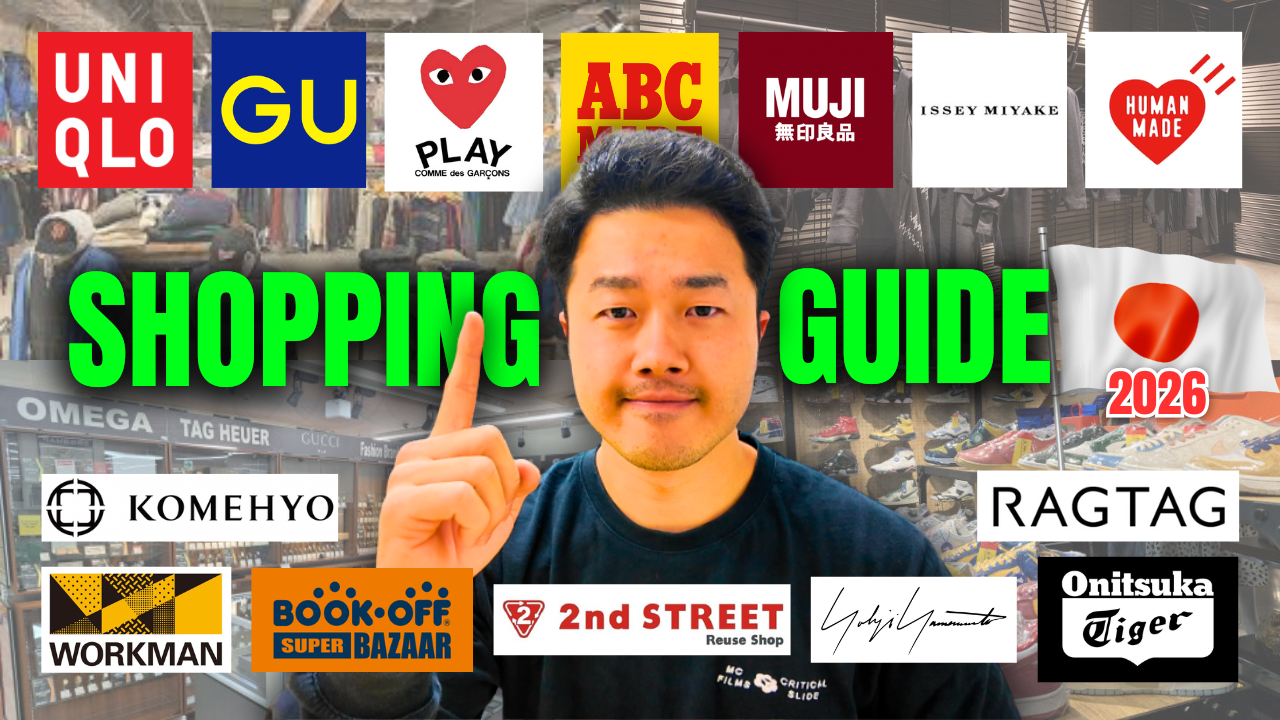
If your Japan trip is about a month away, you’re probably excited… but also slightly stressed. Because fashion shopping in Japan sounds amazing online — until you realize you still have a bunch of real questions. Like…
Where do I actually go if I want clothes?
What’s actually cheaper in Japan?
How do I avoid wasting time in the wrong neighborhood buying stuff?
So in this guide, I’m going to walk you through the full fashion shopping map of Japan — from fast fashion to Japanese streetwear, designer brands, and the best vintage zones in Tokyo.
And most importantly, I’m going to tell you what’s worth buying, where to buy it, and what can trip you up if you don’t know the local rules. So if you want to land in Japan with a game plan, this is for you.
Two Rules That Will Save You Money
Before we start, there are two rules that will save you money.
First: do not trust size letters alone.
In Japan, even if you see Small, Medium, Large, that does not automatically mean it fits the same way as U.S. sizing. Always check the actual measurements, and for shoes, always check the size in centimeters.
Second: if you want tax-free shopping, carry your physical passport with you.
A lot of travelers forget this and lose the discount on the spot.
Fast Fashion
UNIQLO

Let’s start with the obvious giant: UNIQLO. If you’re visiting Japan in the fall or winter, UNIQLO is one of the safest and most practical places to spend money. Their biggest strengths are functional innerwear, clean basics, and outerwear that looks simple but performs well.
Actually, let me show you what I personally wear every single day. I have three holy grail items from Uniqlo that I swear by.
AIRism Seamless version
First is the AIRism Undershirt, but specifically, you need to get the Seamless version. This fabric absorbs your sweat perfectly and is incredibly breathable, so wearing this as a base layer actually makes you feel cooler in the brutal Japanese summer. And because it’s seamless—meaning there are no stitched edges—it stays completely invisible under your button-up shirts or t-shirts. No ugly undershirt lines. It’s an absolute game-changer.
HEATTECH
Second, if you are coming during the winter, you cannot survive without HEATTECH. It uses a genius technology called ‘moisture generation.’ Basically, it absorbs the natural moisture evaporating from your body and converts it into heat, trapping that warmth against your skin. It’s super thin, but it keeps you incredibly warm without making you look bulky.
Ultra Light Down Jacket
This is the ultimate travel hack. Japan’s weather can be tricky—sometimes it’s warm during the day but freezing at night, especially during spring or autumn. That’s when you need this. It gives you the genuine warmth of a down jacket, but look at this—it packs down into this tiny, compact pouch. You can just throw it in your backpack and pull it out whenever you get chilly. Trust me, grab these three when you walk into a Japanese Uniqlo. You’ll thank me later.
Important warning: Do not just grab your usual U.S. size and walk to the register. Check the measurements, compare the fit, and if possible, try things on. UNIQLO’s own guidance basically tells shoppers to use the size info as a reference and check detailed measurements product by product. If you’re tall, broad-shouldered, or usually between sizes in the U.S., this matters even more.
GU

If UNIQLO is where you go to build a reliable wardrobe, GU is where you go when you want to experiment a little without spending much. It’s popular for younger shoppers because you can pick up trend pieces fast and cheap.
What I’d recommend buying: baggy trousers, cargo pants, trendy knits, seasonal jackets, fashion-forward basics, and low-risk trend items you wouldn’t want to pay full U.S. prices for. If you like trying silhouettes that feel a bit more current — wider cuts, cropped layers, trend-heavy casualwear — GU is a strong stop.
Quick caution: At GU, trend cuts can make sizing even trickier. Some items are intentionally oversized, others run short, and some pants look loose online but fit differently in person. So again, don’t rely only on the letter size.
MUJI
If your style is calm, minimal, soft, breathable, and quietly expensive-looking, MUJI is the move. A lot of American travelers think of MUJI as stationery, home goods, or snacks first — but the clothing is seriously worth checking. Especially if you like natural fabrics and neutral colors.
What I’d recommend buying: linen shirts, hemp or linen tops, organic-cotton basics, lightweight pants, soft loungewear, and simple layering pieces that work across different seasons. MUJI is especially good if you want clothing that feels skin-friendly, travel-friendly, and easy to wear in real life rather than just on vacation photos.
Quick caution: MUJI also uses detailed measurement tables, and that’s exactly what you should look at. Don’t shop MUJI by vibe alone. Shop by centimeters.
WORKMAN
This brand started from workwear, but now it’s famous for highly functional clothing at aggressively low prices. If you like practical fashion, outdoor gear, utility style, or just getting a lot of performance for your money, WORKMAN is insanely good.
What I’d recommend buying: rain jackets, UV hoodies, water-resistant outerwear, functional pants, lightweight outdoor layers, gloves, and weather-ready basics. This is a great category for travelers who want something between fashion and utility. It’s also a very good stop if your trip includes hiking, rainy days, or colder mornings and nights.
Quick caution: Here is a crucial insider tip for Workman. If you’re looking for everyday casual wear, the standard Workman stores are okay, but you should definitely look for a store called ‘WORKMAN Plus’ instead. The original Workman is mostly for heavy-duty construction uniforms, which might be a bit too intense. But ‘WORKMAN Plus’ is specially curated for everyday consumers—focusing on stylish, high-quality outdoor gear, rain jackets, and casual clothing. If you want something you can actually wear back home, WORKMAN Plus is where you will find exactly what you’re looking for.
Japanese Street Brands
HUMAN MADE

If you care about global Japanese streetwear, HUMAN MADE is one of the most recognizable names. This is not basic souvenir shopping. This is the kind of brand people specifically put on their Japan itinerary. Harajuku is basically the right emotional home base for it.
What I’d recommend buying: graphic tees, logo caps, varsity-inspired pieces, hoodies, small accessories, and seasonal collaboration items if you get lucky.
Quick caution: If there’s something specific you want, don’t assume it’ll be sitting there all day. Popular graphic pieces and collabs can move fast. If HUMAN MADE is a priority, hit it early in the day, not at 6 p.m. after three coffees and a vintage detour.
Onitsuka Tiger
If you want a Japan buy that still feels practical, stylish, and easy to wear back home, Onitsuka Tiger is one of the best answers. This brand works especially well for travelers who want something more distinctive than mainstream sneakers, but still comfortable enough for actual walking.
And here’s the good part: Omotesando is a power zone for Onitsuka Tiger. There are multiple official stores there, including the regular Omotesando flagship and the NIPPON MADE specialty store.
What I’d recommend buying: MEXICO 66, premium leather models, apparel if you like the brand aesthetic, and especially pieces from the NIPPON MADE line if you want something that really feels Japan-specific. The NIPPON MADE line is the one to pay attention to if you care about craftsmanship. That’s the more elevated, Japan-made lane.
Quick caution: Shoes are sized in centimeters, and that matters. Don’t translate lazily from your U.S. size if you’re buying something you plan to walk in all day. Try both your expected size and the next option if needed.
ABC-MART

Now, let’s be honest. Not everybody wants niche streetwear. Some people just want good shoes, maybe Japanese exclusives, maybe something easy, maybe a sneaker pickup that doesn’t require a whole fashion identity. That’s where ABC-MART, especially ABC-MART GRAND STAGE, is useful. This is a very easy recommendation for sneaker shoppers because it pulls together major brands like Nike, adidas, and Vans, and some locations emphasize store-exclusive or locally special items.
What I’d recommend buying: sneakers, Japan-exclusive colorways if available, everyday walking shoes, socks, insoles, and low-effort footwear upgrades you’ll actually use on the trip. And if your taste leans outdoors, Japan is also strong for practical footwear and outdoor-adjacent apparel shopping in general, especially if you pair this with WORKMAN or outdoor retailers in the same area.
🗺️ Need Turnkey Routes & 1-Tap Google Maps Pins?
Check out our complete 119-page handbook crafted by a Tokyo native—featuring 5-day itineraries and offline navigation.
See What’s Inside the Guidebook →Domestic Japanese Designer Brands
COMME des GARÇONS

This is the classic answer if you want something unmistakably Japanese and globally respected.
What I’d recommend buying: shirts, wallets, smaller leather goods, PLAY items if you want a more accessible entry point, or statement pieces if you already know the line you like.
Quick caution: Comme sizing and cuts can be very intentional. Some pieces are supposed to sit oddly, boxy, cropped, or oversized. Don’t judge it by standard mall-brand fit logic.
ISSEY MIYAKE
If you want something that feels light, architectural, and distinctly Japanese, this is one of the strongest names.
What I’d recommend buying: pleated pieces, lightweight travel-friendly layers, bags, and elegant statement garments that pack well and still look expensive. This is a great stop for people who want fashion that looks artistic but is still wearable.
Quick caution: Some pieces look simple on a hanger and transform completely once worn. So this is another category where trying things on is everything.
Yohji Yamamoto
For people who love darker palettes, drape, avant-garde tailoring, and serious fashion energy, Yohji Yamamoto is the destination.
What I’d recommend buying: black outerwear, tailored pieces, scarves, accessories, and one memorable statement garment rather than five random smaller items.
Quick caution: Yohji pieces can be emotionally persuasive in the fitting room. You may fall in love fast. So go in with a budget, or at least go in honest.
Vintage and Secondhand
Shimokitazawa
Let’s start with the areas. Shimokitazawa — Best for Casual, Trendy, Fun Vintage. If I had to explain Shimokitazawa to an American first-timer in one sentence, I’d say: This is the Disneyland of Tokyo vintage shopping. It’s walkable, laid-back, packed with stores, and fun even if you don’t buy anything. The atmosphere matters here. You can spend hours just drifting between racks, coffee shops, records, and side streets.
What I’d recommend buying: college sweatshirts, denim, workwear, casual jackets, printed tees, easy accessories, and trend-driven vintage you can wear immediately. If you want a high hit-rate area for younger, casual, street-friendly vintage, Shimokitazawa is the safest bet.
Quick caution: Because it’s popular, not everything is a hidden bargain. Some stores are curated and priced accordingly. So don’t confuse “used” with “cheap.” Compare before you buy.
Koenji
Koenji — Best for Serious Vintage, Rock, Military, and Indie Energy. If Shimokitazawa is playful, Koenji is deeper. Koenji feels more for people who really care about clothes — vintage heads, military fans, Americana lovers, rock style people, and shoppers who don’t mind digging.
What I’d recommend buying: real military pieces, older denim, leather jackets, 70s and 80s vintage, boots, band tees, and anything with genuine age and character. This is the spot for people who want less “cute Tokyo thrift day” and more “I found something no one else in my city has.”c
Quick caution: Condition matters more here because you’ll find older, more serious vintage. Check cuffs, collars, zippers, odors, sole separation on footwear, and any alterations before you commit.
Harajuku / Shibuya
Harajuku / Shibuya — Best for Luxury Vintage and Designer Resale. If your budget is bigger and your taste leans designer, then Harajuku and Shibuya are where you go for the cleaner, more polished side of secondhand shopping. This is the zone for luxury vintage bags, designer jackets, archive pieces, and resale that feels less like digging through chaos and more like shopping with intent.
What I’d recommend buying: vintage Louis Vuitton, Chanel, Hermès-adjacent resale pieces, designer outerwear, statement bags, and high-end accessories. This is the best area for travelers who want the thrill of secondhand, but not the mess.
Klook.comTrusted Vintage and Resale Chains
2nd STREET
2nd STREET is one of the easiest secondhand recommendations for overseas visitors. Why? Because it’s huge, it’s everywhere, and for Americans, it already feels somewhat familiar because the brand operates in the U.S. too. This is the place where you can find everything from everyday used clothing to streetwear, vintage, Japanese designers, and luxury accessories.
What I’d recommend buying: sneakers, Japanese labels, affordable jackets, casualwear, and random finds across multiple price levels. If you want a low-pressure, high-volume secondhand experience, this is a very good starting point.
RAGTAG and KOMEHYO


If your priority is designer and high-trust resale, go to RAGTAG and KOMEHYO. This is where you go when you want cleaner presentation, stronger curation, and more confidence in what you’re buying.
What I’d recommend buying: Comme des Garçons, Yohji Yamamoto, Issey pieces, luxury bags, better-condition designer outerwear, watches, and hard-to-find branded items. These are great options if you want secondhand without the anxiety.
Quick caution: Even in high-trust stores, always inspect the condition carefully. “Authenticated” does not mean “like new.” It means real. Those are not the same thing.
BOOKOFF SUPER BAZAAR
BOOKOFF SUPER BAZAAR is chaos in the best way. This is not just books. The big stores can have clothing, bags, watches, sneakers, electronics, and all kinds of secondhand categories under one roof.
What I’d recommend buying: cheap jackets, sportswear, branded bags, random sneaker finds, and “I can’t believe this was here” type items. This is the place for shoppers who enjoy the hunt as much as the final purchase.
Quick caution: The best BOOKOFF SUPER BAZAAR locations are often not the most central or glamorous stop on your itinerary. So go if you genuinely enjoy rummaging — not because TikTok told you every branch is a gold mine.
Japan Shopping Warnings You Really Need to Know
Let me give you the fast version of what actually causes regret.
1. Size confusion
Use centimeters. Check measurements. Try things on. Especially for pants, outerwear, and shoes.
2. Tax-free rules are real, but they’re not magic
Bring your passport, ask before paying, and remember that eligibility and handling fees can vary by store.
3. Vintage pricing is not automatically cheap
Japan is famous for condition, curation, and selection — not always for rock-bottom prices.
If I Were Shopping in Japan for the First Time
If I were shopping in Japan for the first time, here’s the simplest strategy.
If you want practical wins, start with UNIQLO, MUJI, and WORKMAN. If you want Tokyo fashion energy, go to Harajuku, Omotesando, and Shibuya for HUMAN MADE, Onitsuka Tiger, sneakers, and trend shopping. If you want serious fashion, add the Japanese designer stores. And if you want the most memorable finds, give yourself time in Shimokitazawa, Koenji, or the trusted resale chains like 2nd STREET, RAGTAG, KOMEHYO, and BOOKOFF SUPER BAZAAR.
That’s the real balance: buy some practical pieces, buy one or two exciting pieces, and leave space for surprise finds. Because the worst Japan shopping trip is the one where you buy only what the internet told you to buy. The best one is where you understand the categories, know your size, know your budget, and shop with intention.
So if your Japan trip is about a month away, don’t just save random TikToks. Save a strategy. If there’s anything else you’d like to see in a video, let me know in the comments. Thank you for reading until the end. See you in the next one. Bye.

Comments